Pruning that leaves a tree better than it was.
A good prune is mostly invisible. The tree looks like itself, there is more light in the garden, and the cuts are placed where the tree can seal them.
A good prune is mostly invisible. The tree looks like itself, there is more light in the garden, and the cuts are placed where the tree can seal them.
They sound similar. Which one you want depends on whether the problem is light, headroom, or a branch you have stopped trusting.
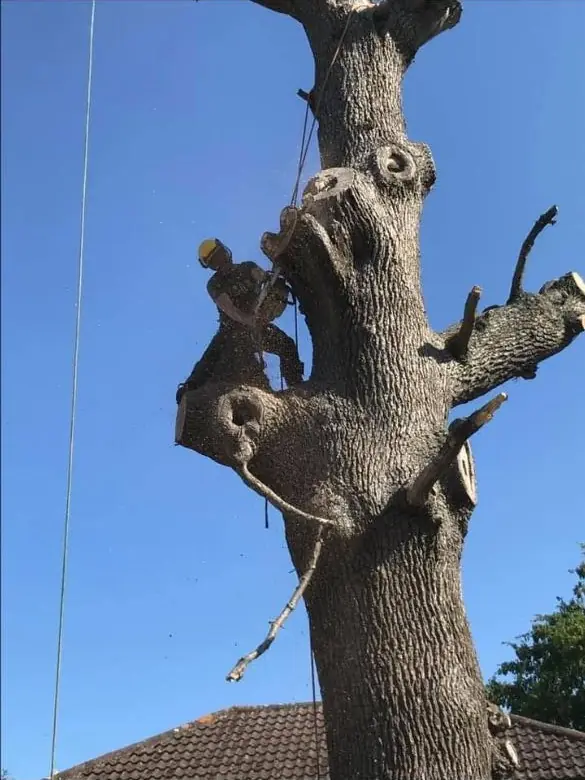
BS3998 is the British Standard for tree work. It sets where a cut goes, and why.
A cut at the branch collar seals. A cut flush to the trunk does not, and leaves a decay route into the stem.
Most trees are fine in winter. Plums and cherries are pruned in summer to keep silver leaf out, and birch and maple bleed heavily in spring.
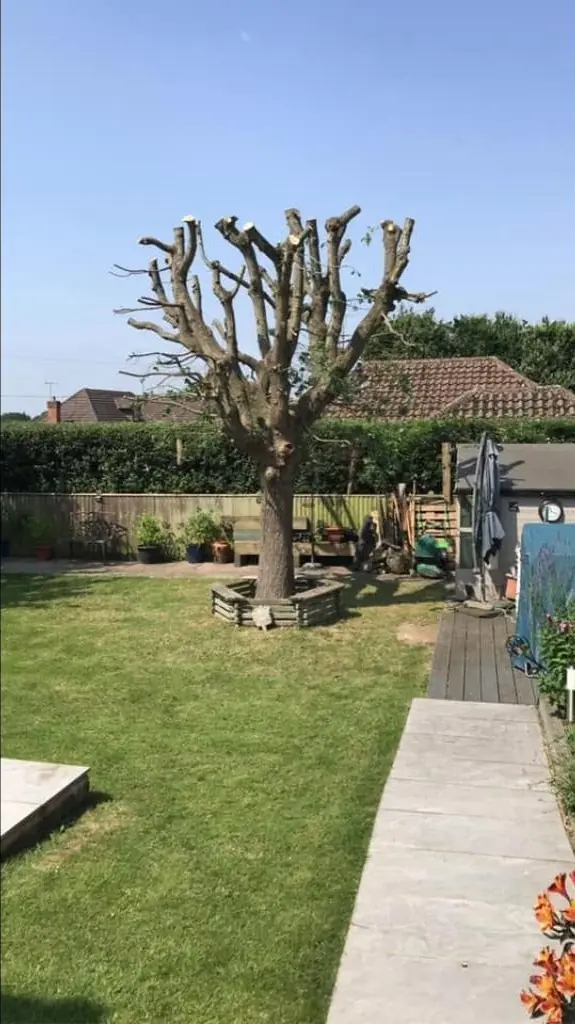
Cutting a crown off at a height leaves stubs, a mass of weak regrowth and a tree that needs doing again in three years.
A reduction is quoted as a percentage off the crown so you know what you are getting before anybody climbs.
Rope and harness on anything being kept, so there are no spike wounds up the trunk.
Arisings chipped and taken, borders raked, and the lawn left walkable.
Describe the problem rather than the solution. Too dark, too close to the roof, a branch you do not like the look of. We will tell you what the job actually is.
For most trees, late autumn through winter while they are dormant. The exceptions matter though. Plums, cherries and the rest of the prunus family are pruned in summer because winter cuts invite silver leaf. Birch, maple and walnut bleed heavily if cut in spring. Tell us the species and we will tell you the month.
We would rather not, and it is worth knowing why before you ask. Topping leaves stubs that cannot seal, the tree throws out a dense mass of weak regrowth, and in a few years you have a worse tree and the same bill. A reduction to growth points gets you the height you want and keeps the shape.
You are entitled to cut back to the boundary, and the cuttings legally belong to the tree owner, so they are offered back rather than tipped over the fence. If the tree is protected, the usual permissions still apply even for your side.
That is agreed before the climb, as a percentage. Most reductions sit between fifteen and thirty percent. Any more and you are into the territory where the tree reacts badly.
Most jobs turn out to be more than one of these. Ask for a price on all of it at once.
Qualified tree felling and sectional dismantling across the Kent, Surrey and Sussex borders.
Crown reductions carried out to growth points, not topped.
Hedge cutting, reshaping and height reduction for homes and commercial sites across Kent, Surrey and Sussex.
Stump grinding and removal across Kent, Surrey and Sussex.
Windblown trees, hung-up limbs and storm damage made safe and cleared across Kent, Surrey and Sussex.
Overgrown plot and site clearance for homeowners, builders and landowners across Kent, Surrey and Sussex.